The Authentic Office: How Real-World Commercial Photography Is Rebuilding Brand Trust
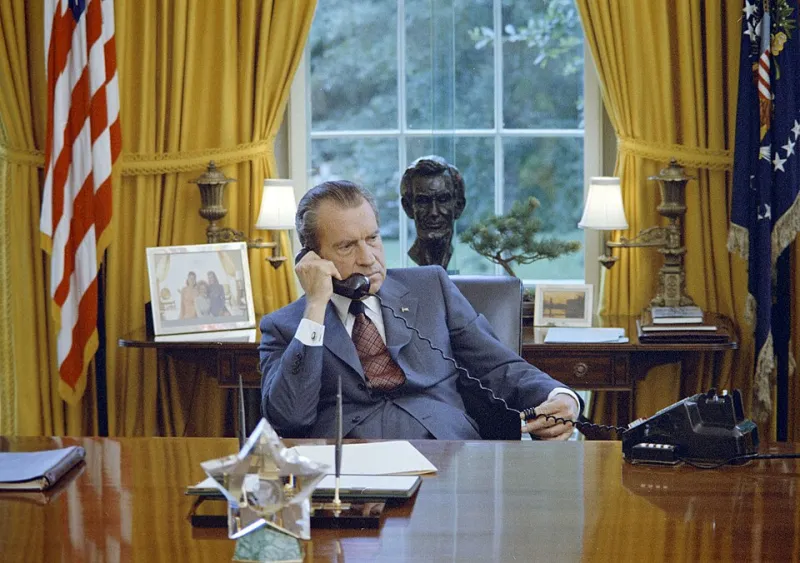
Photo: President (1969-1974 : Nixon). White House Photo Office. 1969-1974, General Services Administration. National Archives and Records Service. Office of Presidential Libraries. Office of Presidential Papers. 1/20/1969-ca. 12/1974, Public domain, via W
For decades, corporate photography followed a predictable formula. Executives posed in front of neutral backgrounds. Teams gathered around conference tables with identical expressions. Lobbies gleamed under flattering light while employees stood at careful attention. The images were technically competent and entirely forgettable — visual wallpaper that said very little about the actual culture of the organization behind them.
That formula is no longer working. Audiences have grown sophisticated enough to recognize the performance, and they are increasingly skeptical of it. In a marketplace where authenticity has become one of the most valuable currencies a brand can hold, the carefully staged corporate photograph has begun to feel like a liability rather than an asset.
What is replacing it is something more interesting, more demanding, and ultimately more effective: commercial photography that captures the genuine texture of a company's daily life.
The Shift From Staged to Spontaneous
The change did not happen overnight. It developed gradually as social media gave consumers direct access to the people behind the brands they follow, and as employees began sharing their own workplace experiences online. The gap between a company's official visual identity and the reality its people described became increasingly difficult to ignore.
Organizations that recognized this gap early began investing in a different kind of commercial photography — one that prioritized candid moments over choreographed ones. Instead of assembling a team in a conference room for a group portrait, they hired photographers to spend a day inside their offices, capturing collaboration in real time. Instead of executive headshots against a seamless backdrop, they commissioned environmental portraits that placed leaders within the context of their actual work.
The results were immediate and measurable. Recruitment marketing that featured authentic workplace photography generated stronger candidate engagement. Client-facing content that showed real employees at work built more credibility than polished renderings of an idealized office environment. The images felt true because they were true, and audiences responded accordingly.
What Authenticity Actually Looks Like
It is worth being precise about what authentic commercial photography means in practice, because the term is frequently misused. Authenticity in this context does not mean unplanned or unpolished. It does not mean handing a smartphone to an intern and hoping for the best. It means working with a professional photographer who has the skill to capture genuine moments without manufacturing them — someone who can move through a workplace environment with enough discretion to allow people to behave naturally, while simultaneously composing images that are technically excellent and visually compelling.
This is a sophisticated discipline. It requires the photographer to understand the brand's visual identity before arriving on location, to develop a shot list that reflects the company's actual story, and to create enough comfort in the environment that employees stop performing for the camera. The resulting images look effortless precisely because so much effort went into creating the conditions for them.
For a technology company in Austin, this might mean capturing engineers in focused conversation around a whiteboard, the natural light of a open workspace softening the frame. For a healthcare organization in Chicago, it might mean documenting the quiet moments between clinical staff — a shared laugh in a break room, a thoughtful exchange in a hallway — that communicate the human dimension of a demanding profession. For a retail brand headquartered in New York, it might mean following a product team through a day of decision-making, building a visual narrative around the creativity and rigor that most customers never see.
Photography as Internal Culture Communication
The audience for commercial photography is not always external. Some of the most impactful applications of authentic workplace imagery are internal — used to communicate values, celebrate milestones, and reinforce a sense of shared identity among employees.
Organizations that invest in professional photography for internal communications send a clear signal to their people: this work matters, these individuals matter, and the culture we are building together is worth documenting with care. That signal is not trivial. In an era when employee engagement and retention are among the most pressing challenges facing American businesses, the visual language a company uses to represent itself internally carries real weight.
Annual reports, internal newsletters, onboarding materials, and company-wide presentations all benefit from photography that reflects the genuine character of an organization. When employees recognize themselves and their colleagues in the images a company chooses to share, the effect on belonging and pride is tangible.
Differentiating in a Crowded Visual Landscape
Every industry has its visual clichés, and most companies default to them without fully considering the cost. When every law firm features the same marble-lobby portrait, every tech startup uses the same open-floor-plan aesthetic, and every healthcare provider relies on the same reassuring-smile formula, the individual brand disappears into the category.
Authentic commercial photography offers a path out of this homogeneity. By investing in imagery that is specific to a particular organization's people, spaces, and culture, a brand creates a visual identity that cannot be replicated by a competitor — because it is rooted in something real and singular.
This specificity is not just aesthetically valuable. It is strategically important. In a business environment where differentiation is increasingly difficult to achieve through product features or pricing alone, the story a company tells about itself — and the visual quality with which it tells that story — becomes a meaningful competitive advantage.
The Professional Difference
None of this is achievable with stock photography or casual smartphone documentation. The images that build brand trust and humanize corporate culture are the product of professional skill, intentional planning, and a genuine understanding of visual storytelling.
At Millie B Photography, commercial engagements begin with a thorough discovery process — learning about a company's values, its people, and the story it most needs to tell. The photography that follows is not an inventory of a workplace. It is a portrait of a culture, composed with the same care and intention that defines every dimension of this practice.
The brands that understand this — and invest accordingly — are the ones building visual identities that audiences remember, trust, and return to. In a world saturated with imagery, that is not a small thing. It is the entire point.